
Workplace Energy: The Performance Metric Leaders Miss
What if the problem isn’t productivity—but the energy behind it?
Workplace energy influences how quickly people make decisions, how openly they communicate, how willing they are to challenge an idea, and how much initiative they bring to the work. Long before performance drops enough to appear on a dashboard, the energy of a team may already be telling leaders that something has changed.
Most organizations track performance obsessively. Revenue. Margin. Productivity. Turnover. Customer satisfaction. Employee engagement. But there is another indicator influencing nearly every one of those metrics that rarely makes it onto an executive dashboard: workplace energy. Before you dismiss that as a little too “woo-woo” for the boardroom, stay with me.
I’m not talking about whether everyone walks into work feeling positive and energized every morning. I’m talking about something far more practical: the energy people bring to decisions, conversations, collaboration, problem-solving, change and execution.
You can feel the difference between a team that is moving and a team that is dragging. You can see it when people are curious versus defensive. When a hard conversation happens quickly instead of being avoided for three weeks. When someone raises a hand to solve a problem instead of waiting to be asked.
Those behaviors have business consequences. And often, they change before your traditional performance metrics do.
Workplace energy is a business issue, not a wellness initiative
When leaders hear the word “energy,” they may associate it with wellness programs, burnout prevention or employee morale. Those things matter, but they are not what I mean by workplace energy.
Workplace energy is the collective capacity people have available to engage with the work and one another. It affects whether people lean into challenges or retreat from them. Whether they collaborate or protect their turf. Whether they solve problems or simply manage around them.
Consider two leadership teams with equally talented people and similar resources. One team debates openly, makes decisions, follows through and adjusts quickly when circumstances change. The other revisits the same conversations, works around unresolved conflict, struggles to get decisions made and spends an enormous amount of time managing internal friction. Their organizational charts might look identical. Their energy profiles are not. And eventually, neither will their results.

Every team has an energy profile
Every team develops patterns around how work gets done. Some create momentum. Others consume it. That combination creates what I think of as a team’s energy profile. It shows up in everyday behaviors: how people enter meetings, how quickly decisions happen, whether disagreements are productive, whether people ask questions, how readily information gets shared, and whether accountability feels normal or exhausting. This is one reason team energy can be such a valuable early indicator of performance.
A leader may look at the numbers and conclude that everything is fine. Meanwhile, the team has stopped challenging assumptions. Meetings are becoming more transactional. Collaboration across functions requires more effort. Decisions take longer. People increasingly escalate issues instead of resolving them. Nothing has “broken” yet. But something has shifted.
Leaders who learn to recognize these changes have an opportunity to influence the conditions creating them before those conditions become larger performance problems.That is a very different leadership capability than waiting for the dashboard to turn red.
Burnout isn’t the first warning sign of declining workplace energy
Burnout gets attention because it is visible. People are exhausted. Engagement scores decline. Absenteeism increases. Strong employees start leaving. But burnout is rarely the first signal that energy is being drained from a team. The earlier signs are easier to dismiss.
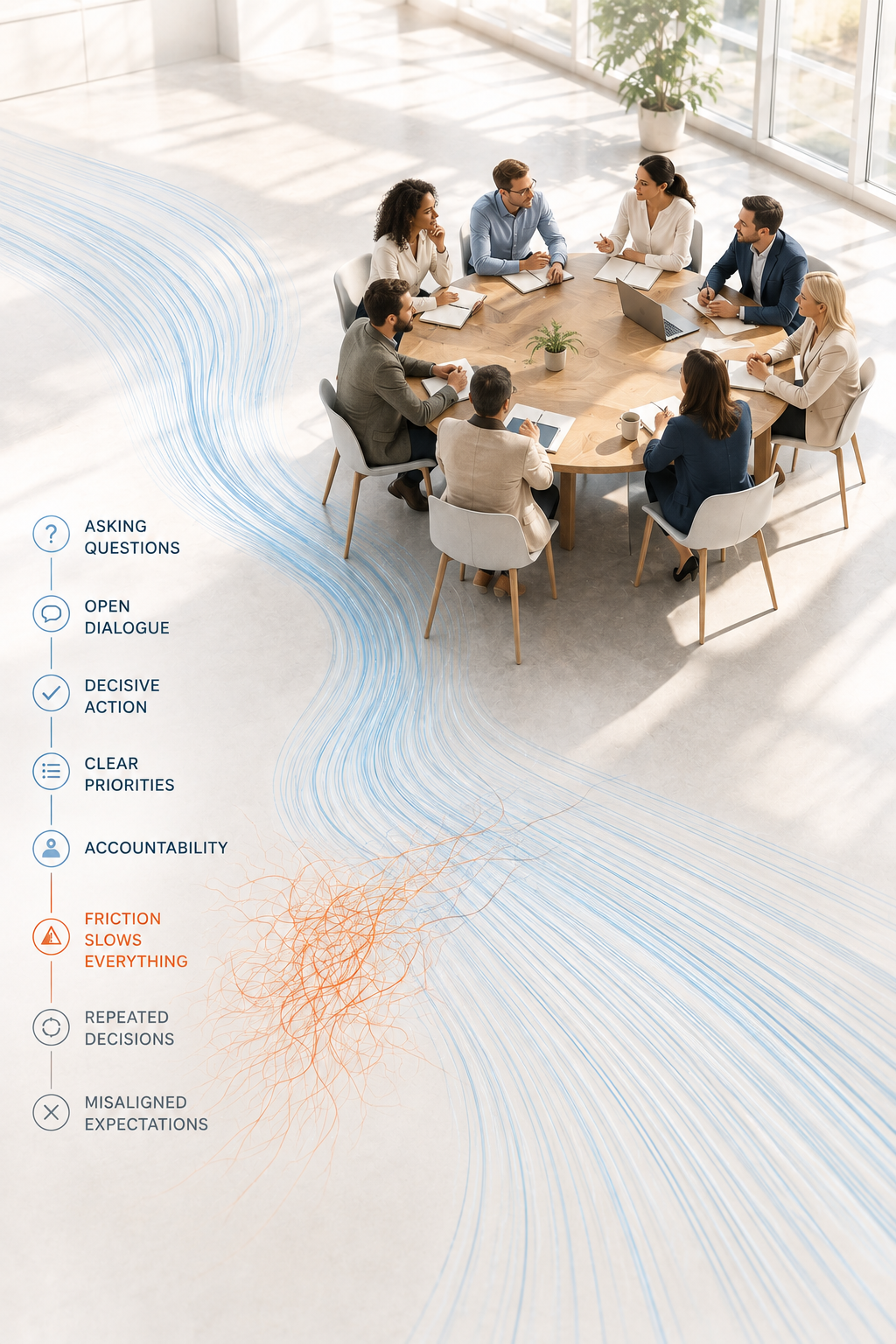
People stop asking as many questions. A normally vocal executive gets quieter. Teams become less willing to challenge one another. Decisions that once took a day take a week. Frustration shows up more frequently. People begin protecting their own function instead of solving for the enterprise. Initiative declines. Meetings become updates instead of working sessions.
Individually, none of these may seem alarming. Together, they tell a story.
And this is where leaders can miss what is happening because they are looking for a performance problem instead of noticing the conditions that may eventually create one.
At CareerFrame, we often say that high-performing leaders don’t struggle because they lack intelligence or effort. They struggle because they can’t see what they can’t see. Workplace energy belongs in that category.
What is draining your team’s energy?
When team energy declines, the instinct can be to focus on the people. Maybe they need to be more motivated. More engaged. More accountable. More resilient. Sometimes they do. But before asking people to bring more energy, leaders should ask a harder question:
What is happening inside our organization that is consuming it?
Unclear priorities consume energy.
Repeatedly revisiting decisions consumes energy.
Avoided conflict consumes energy.
Poor communication consumes energy.
Accountability gaps consume energy.
A leader who regularly steps in and solves problems for the team can consume energy—even when that leader believes they are helping. So can conflicting expectations, organizational silos, unnecessary complexity and the friction created when people do not understand how to work effectively with one another. This is why engaging people requires more than perks, motivation or wellness initiatives. Leaders have to understand the conditions influencing how people experience and contribute to the work.
CareerFrame’s leadership workshops are designed around this idea: helping teams better understand how they are wired, how they interact, and what may be getting in the way of clearer communication, stronger trust and more effective collaboration. Because sometimes the answer isn’t asking people to try harder. It’s removing what is making the work harder than it needs to be.
Workplace energy and workforce engagement are connected—but not identical
There is a reason workforce engagement matters so much to organizations. Gallup’s research on employee engagement and business performance shows that when people feel connected to their work, understand what is expected of them and believe their contribution matters, they are more likely to contribute at a higher level.
But workplace energy gives leaders another lens. An employee can still care deeply about the company and be depleted by how the work gets done. A leadership team can be highly committed and still waste enormous amounts of energy navigating unclear decision rights or unresolved conflict. A high performer can be engaged and still become frustrated when accountability is inconsistent. That distinction matters when leaders are trying to improve employee engagement and retention.
If the only question is, “How do we make people more engaged?” leaders may jump immediately to recognition, benefits, communication campaigns or other engagement initiatives.
A better question might be:
What conditions are helping our people contribute their best energy—and what conditions are making that unnecessarily difficult?
That question moves the conversation from fixing employees to examining the organization.
High-performing organizations manage energy and productivity
Productivity tells you what happened. Energy can help you understand what may happen next.
That doesn’t mean executives need another complicated dashboard or an “energy score” they review every Monday morning. It means leaders should develop the ability to notice and discuss the patterns underneath performance.
Are we still curious?
Are we having the conversations we need to have?
Are decisions moving at the right speed?
Are people taking ownership?
Are we collaborating across boundaries or retreating into functions?
Is the way we are operating creating momentum—or consuming it?
These are business questions. And when leaders pay attention to them, workplace energy becomes less abstract and far more actionable.
This also isn’t about creating relentlessly “positive energy.” High-performing teams will experience tension, disagreement, pressure and difficult seasons. In fact, productive conflict can create energy when it leads to better decisions and greater clarity.
The goal is not positivity. The goal is productive, sustainable energy that supports execution.
The hardest patterns to see are often the ones you’re standing inside
There is one challenge with all of this: leaders are part of the system they are trying to evaluate. If you are inside the meetings, inside the relationships, inside the history and inside the pressure of delivering results, it can be remarkably difficult to see the patterns shaping your team’s behavior.
What feels normal may actually be friction.
What looks like an accountability problem may be a clarity problem.
What appears to be resistance to change may be the result of decisions that were never fully understood or owned.
And what looks like a motivation problem may actually be an energy problem.
This is where the ability to step outside the day-to-day becomes valuable. CareerFrame’s broader leadership development programs help leaders and teams examine how they communicate, collaborate and lead so they can identify patterns that may be difficult to recognize from inside the organization. Because small shifts in workplace energy rarely stay small forever. They eventually show up somewhere—in execution, innovation, culture, engagement, retention or results. The opportunity is to see them sooner.
If your team is working hard but something still feels heavier, slower or more difficult than it should, don’t automatically assume people need to work harder or become more engaged. There may be something underneath the performance that deserves a closer look.

CareerFrame’s leadership workshops help leadership teams step outside the day-to-day, uncover the hidden patterns influencing workplace energy, alignment and performance, and get clearer about what needs to change. Contact CareerFrame to explore how we can support your leadership team.